I had submitted this essay to Insurance Institute of India in June 2024, Over an year later, I thought of publishing it as a blog post. The Indian insurance sector is undergoing a remarkable digital transformation, embracing technologies that were once the stuff of science fiction.
“A customer is the most important visitor on our premises.
He is not dependent on us. We are dependent on him.”— Mohandas Karamchand Gandhi
When Gandhiji spoke about the “premises,” he was referring to a physical place. Today, that idea extends far beyond brick-and-mortar offices. For modern insurers, the premises may be a mobile app, a chatbot interface, a call centre, or a claims portal. Whether physical or virtual, the principle remains unchanged: the customer is not an interruption to the system—the system exists because of the customer.
This perspective is especially relevant in an era where technology increasingly mediates customer interactions. As insurers digitise processes, the responsibility to respect, support, and serve customers does not diminish; it simply shifts to new touchpoints.
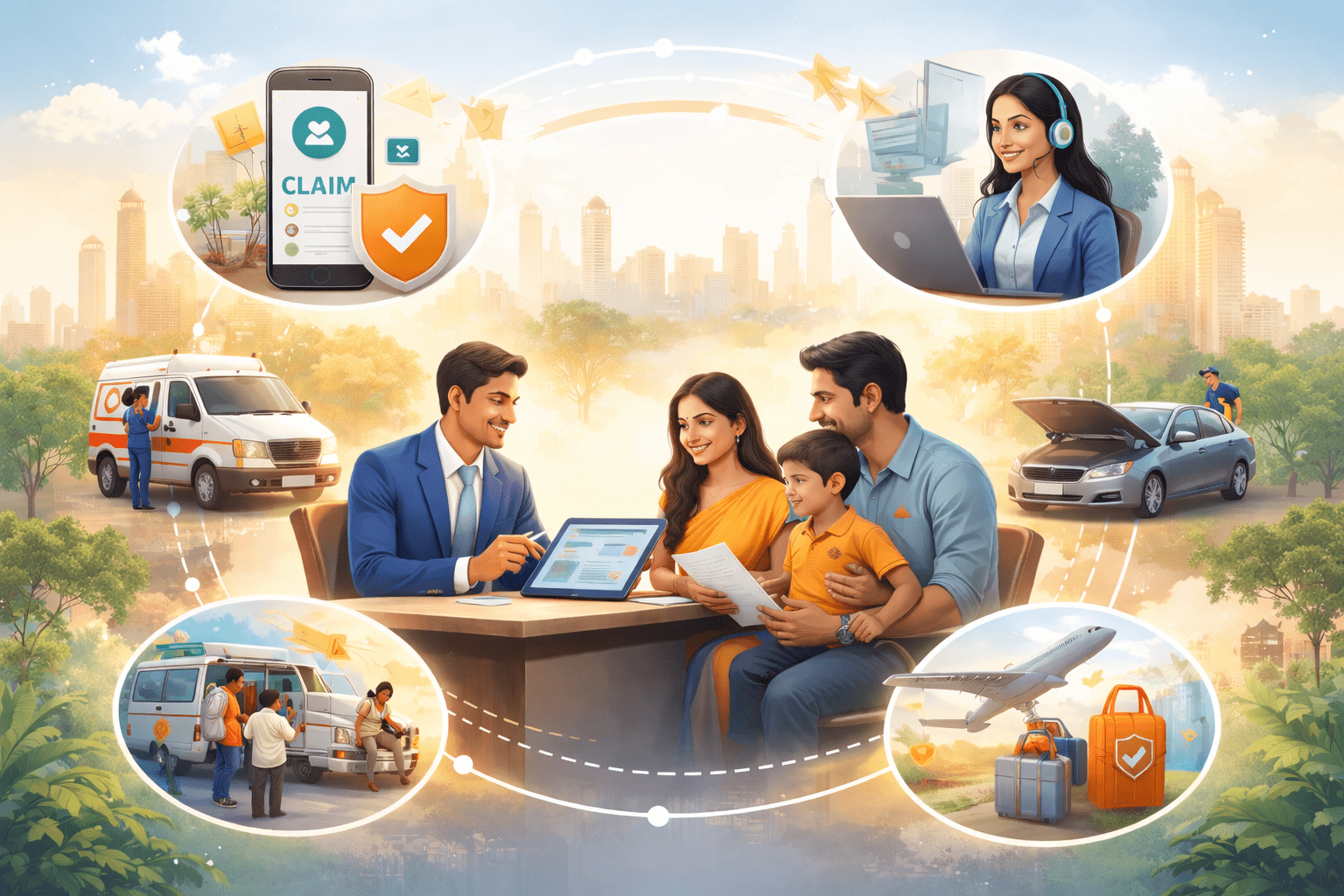
Insurance customer experience using technology in insurance
How Technology Is Transforming Insurance Customer Experience
Over the last decade, technology has reshaped the insurance industry in visible and measurable ways. Digital onboarding, automated underwriting, mobile servicing, and real-time claim updates have steadily raised customer expectations. For insurers, these developments promise efficiency and scalability. For customers, they offer speed, convenience, and easier access to services.
However, insurance is not consumed like a typical digital product. Customers usually interact with insurers during moments of uncertainty—an accident, a medical emergency, or a disrupted journey. In such situations, customer experience cannot be reduced to turnaround times and dashboards alone. Reassurance, clarity, and human support often matter just as much as speed.
Technology has simplified several aspects of the insurance lifecycle, particularly in routine and predictable interactions. Chatbots, mobile applications, and automated workflows have reduced paperwork, improved transparency, and enabled faster claim intimation and servicing.
Consider a common motor insurance scenario. A policyholder travelling from Bengaluru towards the coastal belt experiences a windshield breakage after debris from another vehicle hits the car. Instead of navigating multiple phone calls or visiting an office, the customer initiates a claim through the insurer’s chatbot. Within minutes, the claim is registered. Roadside assistance is arranged, the vehicle is towed to the nearest authorised garage, and a replacement car is organised to help the customer return home.
Such experiences demonstrate how technology can remove friction at moments of inconvenience. When designed well, automation reduces uncertainty and allows customers to focus on resolving the situation rather than managing the process.
A similar transformation is visible in travel insurance. Many insurers now integrate flight status data directly into their systems. When a flight delay crosses the threshold defined in the policy, the claim is triggered automatically. In several cases, the payout is credited directly to the insured’s account without the customer having to submit documents or even raise a request.
Why the Human Touch Still Matters in Insurance
Despite these advances, not all insurance interactions can—or should—be fully automated.
The importance of human intervention became especially evident during the COVID-19 pandemic. Over a short period, India witnessed an unprecedented number of hospitalisations. Many policyholders and families were unfamiliar with policy terms, sub-limits, network hospitals, or claim procedures. At a time of medical and emotional distress, navigating insurance documentation was often the last thing they were prepared for.
In several such cases, it was the human touch—through insurance company representatives, third-party administrators, brokers, or advisors—that helped ease the process. Simple interventions such as explaining coverage, guiding families on documentation, coordinating with hospitals, arranging ambulance services, or setting expectations on claim settlement provided much-needed clarity and reassurance.
While technology supported claim registration and tracking, it was human interaction that helped policyholders make sense of complex situations. The pandemic highlighted that during large-scale crises, empathy, judgment, and communication are as critical as systems and processes.
Insurance, at its core, is a promise. When that promise is tested during moments of distress, the human element becomes indispensable.
Striking the Right Balance
The most effective insurers do not treat technology and human engagement as competing forces. Instead, they design customer journeys where each plays a distinct and complementary role.
Automation works best for routine, low-complexity interactions. Human involvement becomes critical during complex, high-value, or emotionally sensitive claims. Technology should enable people to focus where empathy, discretion, and accountability matter most—not replace them entirely.
Reference to the Original Essay
This article is a practitioner-oriented adaptation of a longer essay written for a journal of the Insurance Institute of India. The original essay examines customer experience from a broader strategic and industry-wide perspective and is currently under consideration for publication.
Readers interested in exploring the detailed arguments and frameworks may refer to the full essay available as a PDF here:
Key Takeaways for improving insurance customer experience
- Technology has improved speed, transparency, and predictability in insurance processes.
- Human support remains essential during complex and emotionally sensitive situations.
- The COVID-19 experience reinforced the value of empathy and guidance in claims handling.
- The future of insurance lies in combining digital capability with human judgment.
Summary (English)
Technology has transformed insurance customer experience by simplifying claims and servicing. However, events such as the COVID-19 pandemic have shown that human support remains crucial during complex and emotionally charged situations. Insurers must design customer journeys that balance digital efficiency with empathy, particularly in the Indian context where trust and clarity are vital.
Summary (Hindi)
बीमा में तकनीक ने प्रक्रियाओं को सरल बनाया है, लेकिन कोविड-19 जैसे संकटों ने यह स्पष्ट किया कि जटिल और भावनात्मक परिस्थितियों में मानवीय सहायता अत्यंत आवश्यक है। बेहतर ग्राहक अनुभव के लिए डिजिटल दक्षता और संवेदनशील मानवीय संवाद का संतुलन जरूरी है।
BIMA GYAAN (Simplified)
IRDAI (Insurance Regulatory and Development Authority of India)
IRDAI is the statutory regulator for the insurance sector in India. Its primary role is to protect the interests of policyholders while ensuring the orderly growth and stability of the insurance industry. IRDAI issues regulations and guidelines covering areas such as policy terms, claims settlement timelines, grievance redressal mechanisms, and conduct standards for insurers and intermediaries.
Editor’s Note:
This post was originally published in October 2025 and last reviewed and updated in January 2026 under the category Insurance Market in India