In a recent interview with Adrian Ladbury, for the publication Commercial Risk : Insurance and Risk Management News, I shared my journey and perspectives on the evolving landscape of Holistic risk management in India.
Risk management is no longer about avoiding failure; it is about enabling better decisions.” — Peter Drucker
What Holistic Risk Management Means in Practice
At its core, holistic risk management integrates multiple functions and perspectives—including insurance, finance, operations, health and safety, legal and compliance, and IT. The objective is to ensure that risk insights are embedded into organisational strategy rather than confined to isolated functional pockets.
You can read the interview by visiting here.
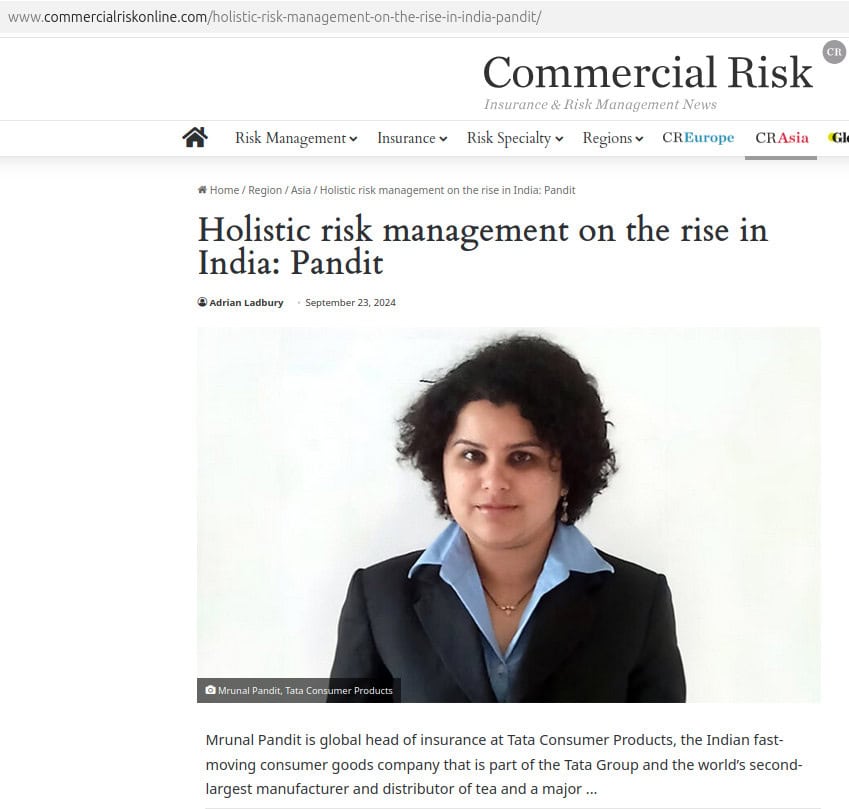
Mrunal Pandit Interview on Commercial Risk Magazine, Sept 2024
Elements of effective holistic risk management
- Enterprise Risk Identification and Categorisation
Recognising risks across strategic, operational, hazard, and financial domains. - Integrated Assessment Frameworks
Evaluating risks using both quantitative measures (such as probability and financial exposure) and qualitative insights (such as strategic impact). - Cross-Functional Collaboration
Ensuring that risks such as cyber, climate, regulatory, and supply-chain disruptions are understood collectively rather than in isolation. - Data-Driven Decision Making
Leveraging analytics and trend data to support risk prioritisation and mitigation strategies.
This methodology contrasts with reactive approaches that respond only after events occur. Instead, it positions risk management as a proactive discipline that anticipates uncertainty and shapes responses before risks materialise.
The Strategic Value for India’s Business Ecosystem
India’s evolving risk environment—from cyber threats to climate-related natural catastrophes—has necessitated more mature risk functions. Industry observations increasingly show that Indian leaders view risk not only as a threat, but also as a potential source of competitive advantage when managed effectively.
In parallel, risk professionals in India are pursuing advanced credentials such as RIMS-CRMP (Certified Risk Management Professional) to build structured, globally aligned enterprise
risk management frameworks. Such professional development strengthens the credibility of the risk function and enhances its influence within organisations.
Bimagyaan Simplified: Risk Retention Versus Risk Transfer
Risk Retention is the process of accepting the potential financial consequences of risks by choosing not to transfer them, often by setting aside reserves to cover potential losses.
Risk Transfer involves shifting the financial burden of a risk to another party, typically through insurance contracts or outsourcing arrangements, to mitigate potential losses
Holistic risk management enables smarter decisions between risk retention and risk transfer. Not every risk needs insurance. Some are better retained based on frequency, severity, and strategic relevance—while others are best transferred to insurers to protect balance sheets and ensure resilience.
Conclusion: The Road Ahead
Holistic risk management in India is no longer aspirational; it is becoming integral to corporate governance and strategic execution. Risk managers are playing a key role in this evolution by emphasising enterprise-wide thinking, data-informed frameworks, and strategic foresight.
As organisations navigate an increasingly uncertain and complex environment, embedding comprehensive and integrated risk practices will be essential to building long-term resilience and sustainable growth.
You may also like to read:
- Interview with Risk and Insurance Management Society
- Winning RIMS Honour Roll 2024
- How Internal Partnerships Foster Risk Insurance Management
Note: This interview was conducted as part of the Risk Frontiers Asia survey, sponsored by HDI Global.
